
Who is the Jazariyyah for?
Students crossing from following the rules to knowing the science.
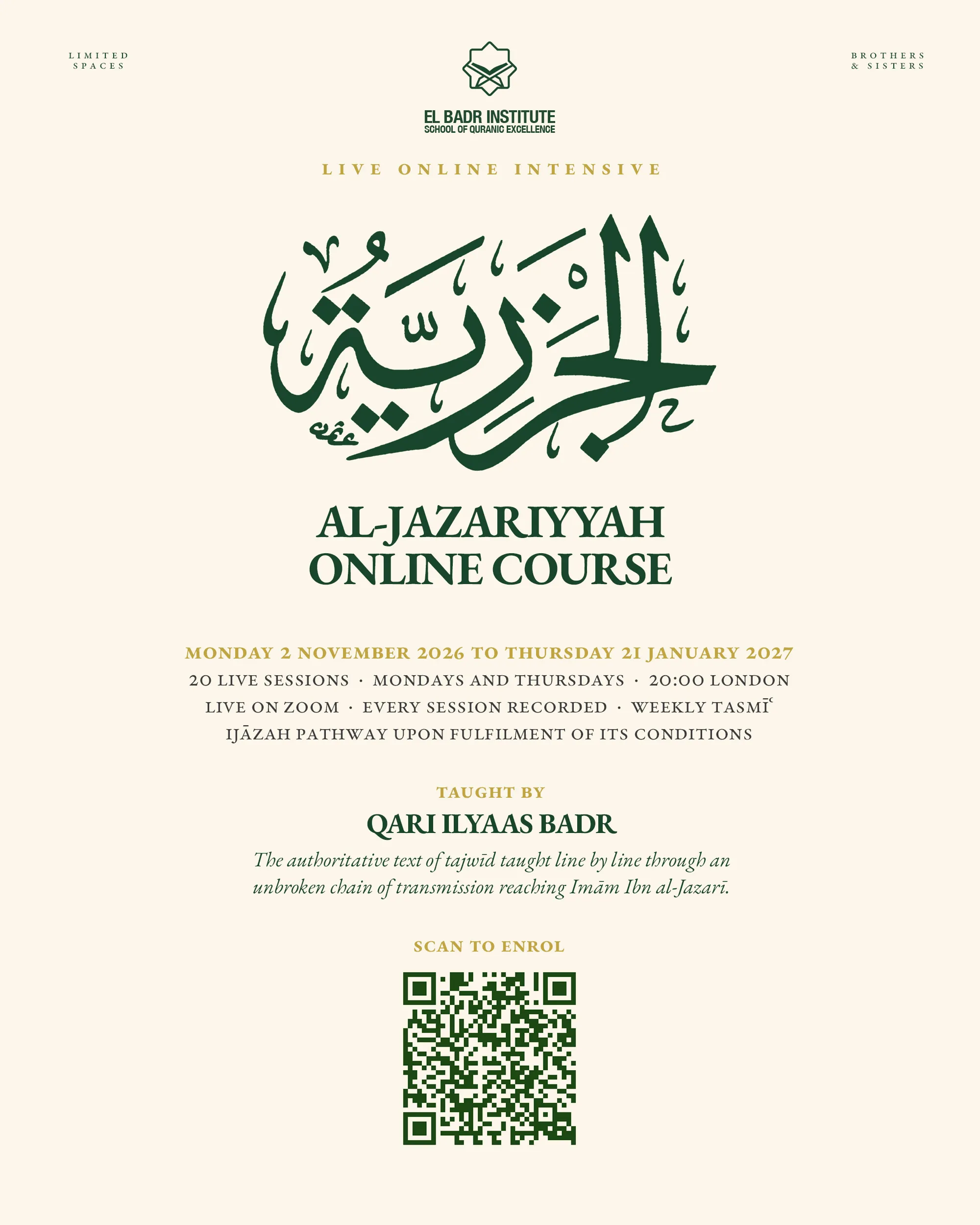
More than six hundred years ago, Imam Ibn al-Jazarī, the leading authority on the recitation of the Quran in his age, set down in just over a hundred lines what every reciter needs to know: where each letter is born, the qualities that give it its sound, and the rules that keep recitation true. Students have memorised his Muqaddimah ever since. In 20 live sessions on Zoom, we read it together line by line, in clear English, with Qari Ilyaas Badr, whose chain of transmission in the poem reaches Ibn al-Jazarī himself.
If you have ever wondered why a letter is pronounced the way it is, this course is for you.
Show more
Show less
Taught live online, in English, and open to brothers and sisters.
Note: Two ways to take the course. On the Study Track you learn the poem and its rules and earn a Certificate of Completion. On the Memorisation Track you also memorise the full text and recite it back in weekly tasmīʿ sessions, and you may be considered for an ijāzah in the poem, at the teacher's discretion, with a chain reaching Imam Ibn al-Jazarī.
Students crossing from following the rules to knowing the science.
auto_stories
You've learned some tajwīd along the way: a bit of ghunnah, a bit of madd, the rules of nūn sākinah. But you've never been sure why the rules are what they are. Here, line by line, the pieces finally come together.
psychology
You read every day, in ṣalāh or from the muṣḥaf, and want to know you are getting it right. You will learn where each letter comes from and how it should sound, and hear the difference in your own recitation.
history_edu
You may be memorising the Quran, teaching your children or students, or hoping to study the readings one day. The Jazariyyah is the foundation all of that is built on, and you will learn it with a chain that reaches its author.
The book, chapter by chapter
01
Ibn al-Jazarī, the imam of the science, and what he obliges every reciter to know in the opening eight lines.
02
The seventeen points of articulation, from the open space of the mouth to the nasal passage, found on the chart and then in your own recitation.
03
The qualities that give each letter its own sound. Once you can describe a letter, many common mistakes simply disappear.
04
The chapter that makes tajwīd a duty, its famous line on reciting without it, and the difference between clear errors and hidden ones.
05
Ibn al-Jazarī's precise warnings: keeping light letters light, giving the hamzah its clarity, and separating similar sounds that sit side by side.
06
When the rāʾ and the lām in the name of Allah are heavy and when they are light, with the disputed cases and the reasoning behind them.
07
The two letters most often confused in recitation, separated clearly and for good.
08
The silent mīm, the doubled nūn and mīm, then iẓhār, idghām, iqlāb and ikhfāʾ, in the order the poem gives them.
09
Lengthening: its causes, its ranks and its counts, and how the poem fits the whole system into four lines.
10
Where to stop and where to begin. The chapter that changes how every page sounds when read aloud, counted by the scholars as half of tartīl.
11
The words the ʿUthmānī script writes separately or joined, and the thirteen words written with an open tāʾ, and why they matter when you stop.
12
How to begin on the connecting hamzah, rawm and ishmām at the ends of words, and the poem's own closing lines.
We teach the poem the way it has always been taught: read, explained, memorised and recited back to a teacher whose own chain in the text stands behind every explanation. Nothing is skipped. Every line of the commonly printed text, all 109 of them, is covered.
And every chapter ends up in your mouth, not just your notebook. Each week the lines are practised in live recitation of the Quran, and tasmīʿ follows the lessons, because the Jazariyyah was written to be recited and revised, not left on a shelf.
Live Online Cohort
£250 for the full course of 20 live sessions, starting Monday 2 November 2026 at 20:00 London time. Open to men and women. Places are limited, and enrolment closes when the cohort is full.
Live group class, twice per week
20 sessions · 2 Nov 2026 to 21 Jan 2027
Terms. Payment is made in full at enrolment and secures your place for the whole course. Recordings are shared to the private cohort playlist within 24 hours of each session.
One hundred and nine lines felt impossible in week one. By the last session I was reciting them with meaning, not just memory.
The pace was demanding in the best way. By the doubled sessions at the end I could feel how far the group had come together.
I'd tried to memorise the poem alone twice and given up. In a structured cohort with weekly recitation, I finished it.
Sunday evenings became the anchor of my week. A live class, a clear text, and a teacher who checked I could recite it back before moving on.
Studying directly with Shaykh Ilyaas is not something I expected to have access to from my own home. It raised the level of everything.
The weekly listening sessions is what made it stick. Knowing I had to recite back what I'd memorised kept me consistent for the full course.
From our students
Mentorship runs in terms of twelve sessions, renewing automatically so your teacher and time slot stay yours. Cohort courses run to fixed dates published on each course page. How far you travel within that time depends on your starting level and your consistency; your roadmap makes the path explicit.
We do not offer trials, and deliberately so. Enrolment is a minimum commitment of one term of twelve lessons, because that is the shortest span in which real change in recitation takes root. Your first session is a working session, and if you would like a professional assessment before committing, the Consultation exists exactly for that.
For most courses, no; your first session with your teacher includes a full diagnostic, so the work begins immediately. The advanced pathways, Ijāzah, Qirāʾāt, and Maqāmāt, open with a paid Recitation Consultation so your readiness is confirmed before study begins. Each course page tells you if one is needed.
You receive an official welcome and a short onboarding form so we can learn your level, goals, and availability. We confirm your weekly time, match you to your dedicated Ijāzah certified teacher, and your roadmap is ready before your first lesson.
Yes. Choose your course or mentorship tier and enrol directly on its page; your place is secured the moment you enrol. Where a course is full you join the waiting list in order of priority, or your payment is returned in full.